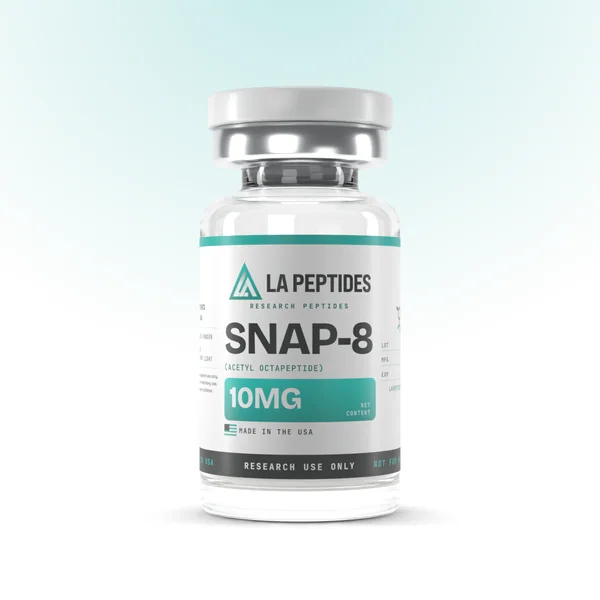
SNAP-8 is an acetylated synthetic octapeptide modeled on the N-terminal domain of SNAP-25. Supplied as a lyophilized powder in sealed vials. Each batch has its own certificate of analysis (COA), which opens when you scan the QR code on the label. For laboratory research use only. Not for human or veterinary use.
SNAP-8 (INCI: Acetyl Octapeptide-3) is a synthetic, N-acetylated and C-amidated octapeptide modeled on the N-terminal end of SNAP-25, a protein of the SNARE complex. It is an elongated version of acetyl hexapeptide-3 (Argireline), with two additional residues, Ala-Asp, at the C-terminus.
No. SNAP-8 is an octapeptide (8 residues). Argireline, acetyl hexapeptide-3, has 6 residues. SNAP-8 adds Ala-Asp to the same N-terminal sequence. See our comparison guide.
Acetyl Octapeptide-3. Some catalogs also list it as Acetyl Glutamyl Heptapeptide-3.
Each vial contains 10 mg of lyophilized SNAP-8.
Scan the QR code on the vial to open the certificate of analysis for that lot.
For laboratory research use only. Not for human or veterinary use. Not intended to diagnose, treat, cure or prevent any disease. Literature references are provided for scientific context and do not describe this product's suitability for any use.
SNAP-8 is part of this research bundle. See all bundles
BPC-157 vs TB-500: two research peptides compared · Reading a mass spectrum on a peptide COA: m/z, charge states and adducts · GHK-Cu blends explained: GLOW and KLOW compositions · CJC-1295 with and without DAC: what the names mean · Short peptide bioregulators: an overview for researchers · Why a peptide's molecular weight can differ: salts, caps and oxidation · Thymosin alpha-1: structure, history and research · Epitalon (AEDG): what the research covers · KPV: the α-MSH tripeptide explained · MOTS-c: the mitochondrial-derived peptide explained · Adamax and Semax: what is known about this analog · Selank: the tuftsin-derived heptapeptide explained · SNAP-8 vs Argireline: two SNAP-25 mimic peptides compared · AHK-Cu vs GHK-Cu: comparing two copper tripeptides · GHK-Cu: structure, history and published research · HPLC purity: what the percentage on a COA means · Mass spectrometry: how a peptide's identity is confirmed · How to verify a lot with the QR code on the vial · Lyophilized peptides: what they are and how labs store them · How to choose a research compound supplier: 7 points


