100% manufactured in the USABatch-specific COAs on tested lots76 research compounds in stockFor research use onlyFree shipping on orders over $200100% manufactured in the USABatch-specific COAs on tested lots76 research compounds in stockFor research use onlyFree shipping on orders over $200100% manufactured in the USABatch-specific COAs on tested lots76 research compounds in stockFor research use onlyFree shipping on orders over $200100% manufactured in the USABatch-specific COAs on tested lots76 research compounds in stockFor research use onlyFree shipping on orders over $200
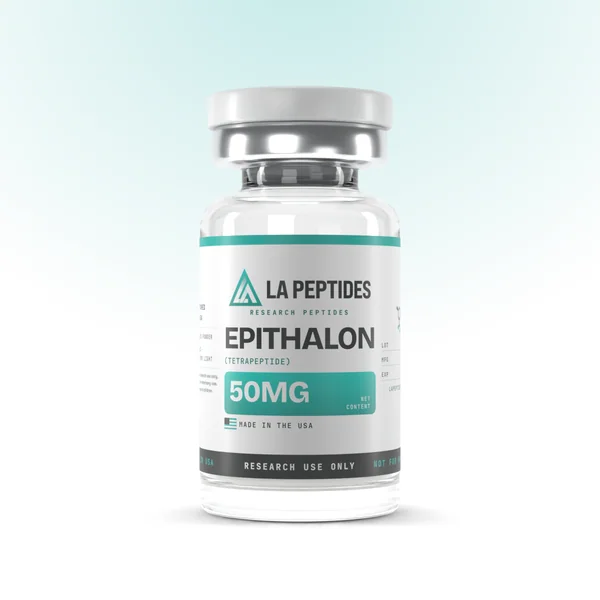
Epithalon is a synthetic tetrapeptide (Ala-Glu-Asp-Gly). Supplied as a lyophilized powder in sealed vials. Each batch has its own certificate of analysis (COA), which opens when you scan the QR code on the label. For laboratory research use only. Not for human or veterinary use.
Research use only. Not for human or veterinary use. Not intended to diagnose, treat, cure or prevent any disease.
Research profile
Epitalon research profile
Epitalon (also spelled Epithalon; sequence AEDG) is a synthetic tetrapeptide described as the putative active component of epithalamin, a bovine pineal gland extract. Almost all of its published research comes from V. Kh. Khavinson's group at the St. Petersburg Institute of Bioregulation and Gerontology.
Specifications
Sequence
Ala-Glu-Asp-Gly (AEDG)
Molecular formula
C14H22N4O9
Molecular weight
≈ 390.3 g/mol
CAS number
307297-39-8
Size
50MG per vial
Form
Lyophilized powder, sealed vial
Storage
Keep sealed, protected from light and moisture; follow the label
Testing
HPLC purity and mass spectrometry identity, per lot. Scan the QR code on the vial for the certificate of analysis.
Published research
Telomerase in cell culture: human fetal lung fibroblasts (Khavinson, Bondarev & Butyugov, Bull Exp Biol Med, 2003).
Aging markers and tumour development in transgenic HER-2/neu mice (Anisimov, Khavinson et al., Bull Exp Biol Med, 2002).
Free-radical and antioxidant enzyme measures in rats (Kozina et al., Bull Exp Biol Med, 2007).
Note: the literature comes mostly from one research group.
Both spellings refer to the same tetrapeptide, Ala-Glu-Asp-Gly (AEDG).
What is epithalamin?
A bovine pineal gland extract. Epitalon is described as its putative active component.
How do I verify my lot?
Scan the QR code on the vial. It opens the certificate of analysis for that lot, with HPLC purity and the mass spectrometry identity result.
For laboratory research use only. Not for human or veterinary use. Not intended to diagnose, treat, cure or prevent any disease. Literature references are provided for scientific context and do not describe this product's suitability for any use.