$9.00/mg
Sprays
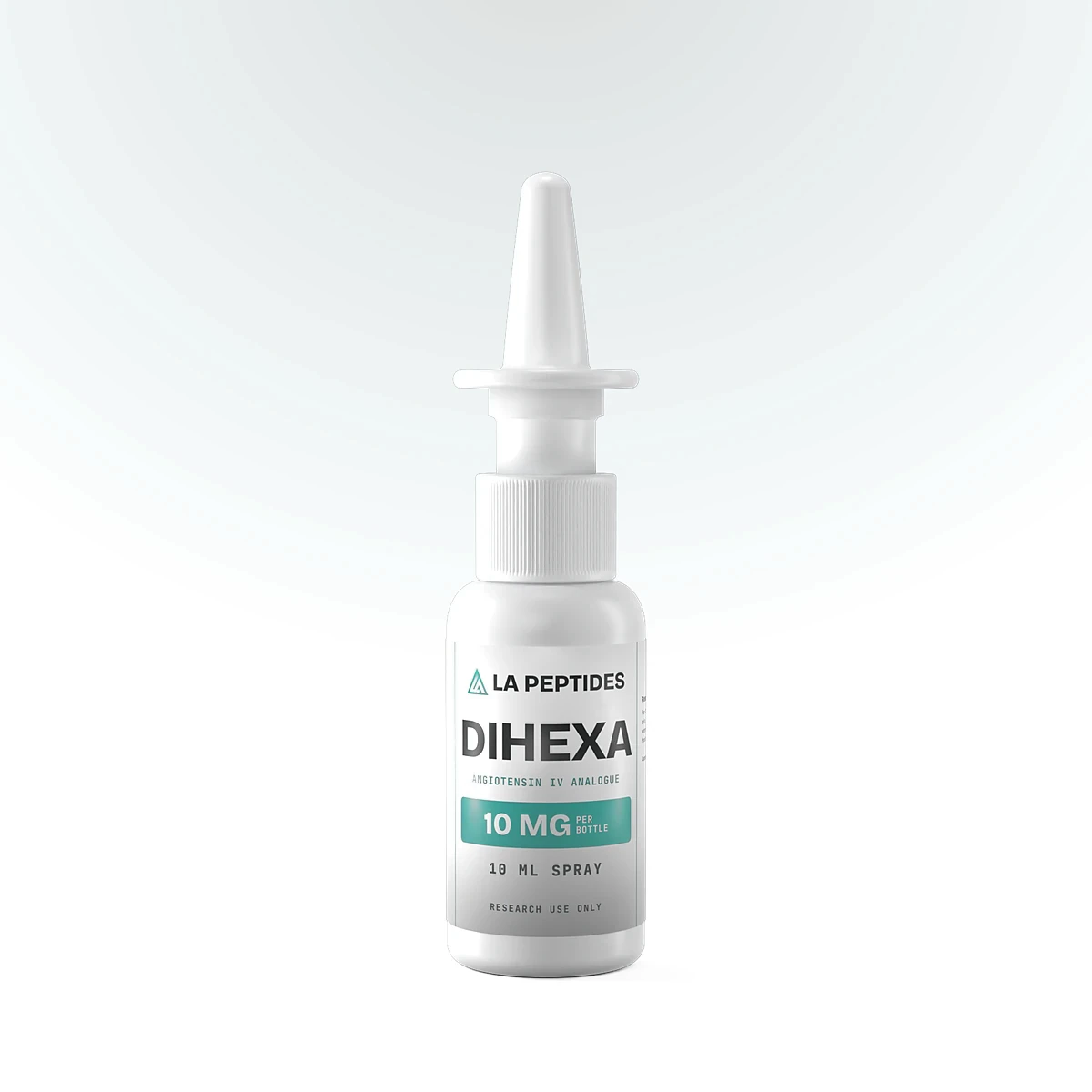
Dihexa Spray
Made in the USA
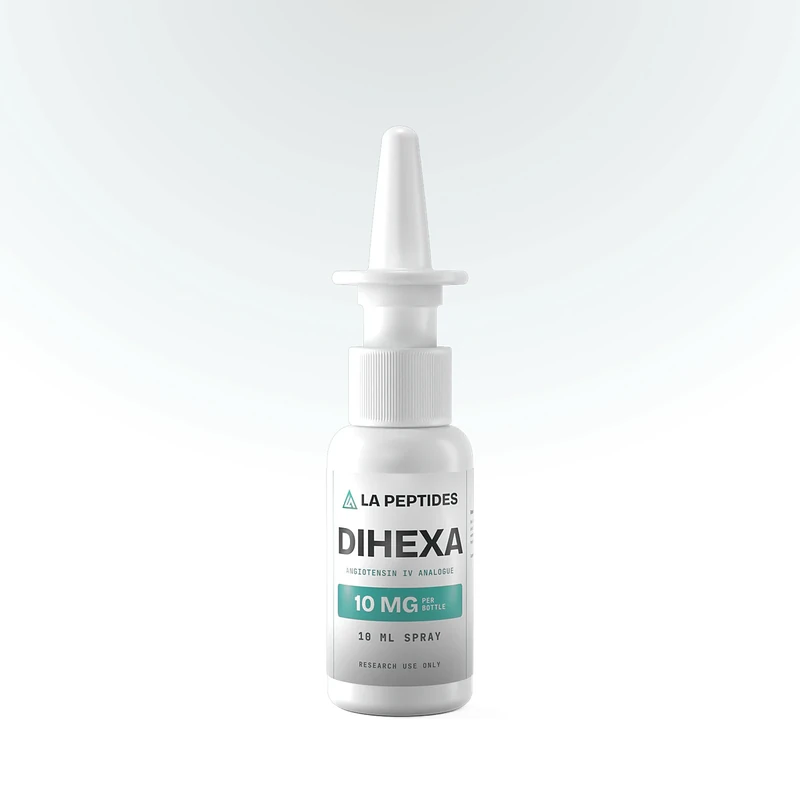
Dihexa, a synthetic angiotensin IV–derived compound, in a buffered aqueous solution.
Dihexa, a synthetic angiotensin IV–derived compound, in a buffered aqueous solution. Supplied in a spray bottle. For laboratory research use only. Not for human or veterinary use.
Contents: 10 mg Dihexa per 10 mL bottle.
In stock
Order by 2 PM PT for same-day dispatchMonday to Friday, except holidays. Tracking is emailed when it ships.
- Free shipping + BAC waterA free 10 mL vial of BAC water on orders of $200 or more
Research use only. Not for human or veterinary use, and not intended to diagnose, treat, cure or prevent any disease.
Research profile
Dihexa research profile
Dihexa (N-hexanoic-Tyr-Ile-(6) aminohexanoic amide, also PNB-0408) is a small peptidomimetic derived from angiotensin IV. It was developed by Joseph Harding's group at Washington State University, who reported that it binds hepatocyte growth factor (HGF) and enhances HGF activity at its receptor, c-Met. Its phosphate prodrug, fosgonimeton, has been examined in early clinical research.
Specifications
- Structure
- Hexanoyl-Tyr-Ile-NH-(CH2)5-CONH2 (N-hexanoic-Tyr-Ile-(6) aminohexanoic amide)
- Molecular formula
- C27H44N4O5
- Molecular weight
- ≈ 504.7 g/mol
- CAS number
- 1401708-83-5
- Form
- Supplied in spray format
- Storage
- Keep sealed, protected from light and moisture; follow the label
Published research
- Design and evaluation: metabolically stabilized angiotensin IV analogs, liver microsome stability, hippocampal synaptogenesis in culture, and scopolamine-treated and aged rats in the Morris water maze (McCoy et al., J Pharmacol Exp Ther, 2013).
- HGF/c-Met dependence of synaptogenic and behavioural measures in rats and cultured hippocampal neurons (Benoist et al., J Pharmacol Exp Ther, 2014). The journal later published a notice of concern about possible image manipulation in this article.
- Earlier C-terminally truncated Nle1-angiotensin IV analogs and dendritic spine formation (Benoist et al., J Pharmacol Exp Ther, 2011).
- Zebrafish lateral-line hair cells exposed to aminoglycosides (Uribe et al., Front Cell Neurosci, 2015).
- Review of the brain HGF/c-Met system: Wright & Harding, J Alzheimers Dis, 2015.
Frequently asked questions
Is dihexa a peptide?
It is a modified dipeptide (Tyr-Ile) with an N-terminal hexanoyl group and a C-terminal 6-aminohexanoic amide, often described as a peptidomimetic.
What formats are available?
Dihexa is supplied in capsule format and in spray format, for laboratory research only.
For laboratory research use only. Not for human or veterinary use. Not intended to diagnose, treat, cure or prevent any disease. Literature references are provided for scientific context and do not describe this product's suitability for any use.
Related compounds
 Dihexa Spray$59.99
BPC-157 vs TB-500: two research peptides compared · Reading a mass spectrum on a peptide COA: m/z, charge states and adducts · GHK-Cu blends explained: GLOW and KLOW compositions · CJC-1295 with and without DAC: what the names mean · Short peptide bioregulators: an overview for researchers · Why a peptide's molecular weight can differ: salts, caps and oxidation · Thymosin alpha-1: structure, history and research · Epitalon (AEDG): what the research covers · KPV: the α-MSH tripeptide explained · MOTS-c: the mitochondrial-derived peptide explained · Adamax and Semax: what is known about this analog · Selank: the tuftsin-derived heptapeptide explained · SNAP-8 vs Argireline: two SNAP-25 mimic peptides compared · AHK-Cu vs GHK-Cu: comparing two copper tripeptides · GHK-Cu: structure, history and published research · HPLC purity: what the percentage on a COA means · Mass spectrometry: how a peptide's identity is confirmed · How to match your vial to a published COA · Lyophilized peptides: what they are and how labs store them · How to choose a research compound supplier: 7 points