COAUSA
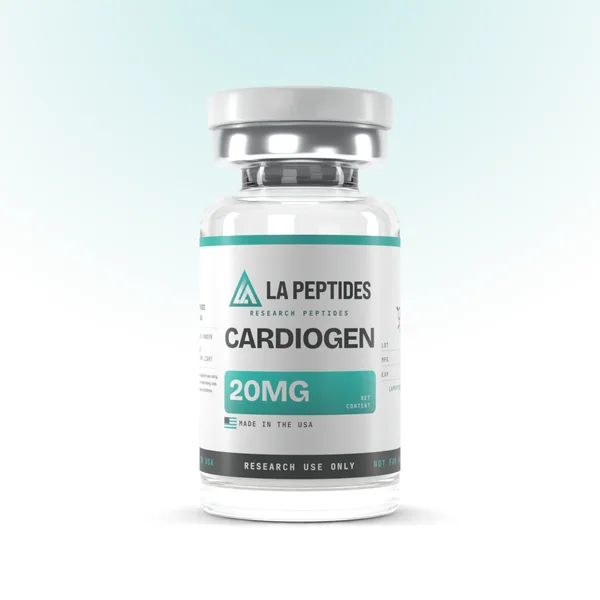
Cardiogen
Bioregulators
$59.99$3.00/mg

Crystagen is a synthetic tripeptide bioregulator (Glu-Asp-Pro). Supplied as a lyophilized powder in sealed vials. Each batch has its own certificate of analysis (COA), which opens when you scan the QR code on the label. For laboratory research use only. Not for human or veterinary use.
Crystagen (also spelled Cristagen) is the name used for the synthetic tripeptide Glu-Asp-Pro (EDP). It was developed by V. Kh. Khavinson's group, and EDP has been reported as a minor component of thymalin, a polypeptide complex isolated from calf thymus. Published work covers tissue explants, cell cultures, rodent models and molecular docking.
Both spellings are used for the same tripeptide, Glu-Asp-Pro (EDP).
About 359.3 g/mol for the free tripeptide, consistent with the 359.33 value given in the developers' patent.
Scan the QR code on the vial. It opens the certificate of analysis for that lot, with HPLC purity and the mass spectrometry identity result.
For laboratory research use only. Not for human or veterinary use. Not intended to diagnose, treat, cure or prevent any disease. Literature references are provided for scientific context and do not describe this product's suitability for any use.
BPC-157 vs TB-500: two research peptides compared · Reading a mass spectrum on a peptide COA: m/z, charge states and adducts · GHK-Cu blends explained: GLOW and KLOW compositions · CJC-1295 with and without DAC: what the names mean · Short peptide bioregulators: an overview for researchers · Why a peptide's molecular weight can differ: salts, caps and oxidation · Thymosin alpha-1: structure, history and research · Epitalon (AEDG): what the research covers · KPV: the α-MSH tripeptide explained · MOTS-c: the mitochondrial-derived peptide explained · Adamax and Semax: what is known about this analog · Selank: the tuftsin-derived heptapeptide explained · SNAP-8 vs Argireline: two SNAP-25 mimic peptides compared · AHK-Cu vs GHK-Cu: comparing two copper tripeptides · GHK-Cu: structure, history and published research · HPLC purity: what the percentage on a COA means · Mass spectrometry: how a peptide's identity is confirmed · How to verify a lot with the QR code on the vial · Lyophilized peptides: what they are and how labs store them · How to choose a research compound supplier: 7 points