100% manufactured in the USABatch-specific COAs on tested lots76 research compounds in stockFor research use onlyFree shipping on orders over $200100% manufactured in the USABatch-specific COAs on tested lots76 research compounds in stockFor research use onlyFree shipping on orders over $200100% manufactured in the USABatch-specific COAs on tested lots76 research compounds in stockFor research use onlyFree shipping on orders over $200100% manufactured in the USABatch-specific COAs on tested lots76 research compounds in stockFor research use onlyFree shipping on orders over $200
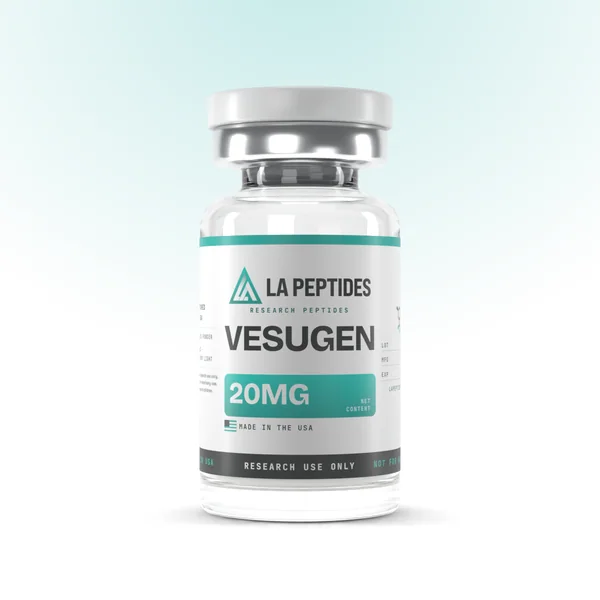
Vesugen is a synthetic tripeptide bioregulator (Lys-Glu-Asp). Supplied as a lyophilized powder in sealed vials. Each batch has its own certificate of analysis (COA), which opens when you scan the QR code on the label. For laboratory research use only. Not for human or veterinary use.
Research use only. Not for human or veterinary use. Not intended to diagnose, treat, cure or prevent any disease.
Research profile
Vesugen research profile
Vesugen is the name used for the synthetic tripeptide Lys-Glu-Asp (KED), coded T-38 in some papers. It was developed by V. Kh. Khavinson's group, and KED has been studied in thymus, fibroblast, stem-cell and neuronal cultures and in a mouse model of Alzheimer's disease.
Specifications
Sequence
Lys-Glu-Asp (KED)
Molecular formula
C15H26N4O8
Molecular weight
≈ 390.4 g/mol
CAS number
204271-66-9
Size
20MG per vial
Form
Lyophilized powder, sealed vial
Storage
Keep sealed, protected from light and moisture; follow the label
Testing
HPLC purity and mass spectrometry identity, per lot. Scan the QR code on the vial for the certificate of analysis.
Published research
Human embryonic thymus cell cultures: Ki-67, p53 and Mcl-1 expression and CD4/CD8 profiles measured after exposure to T-38 (KED) and T-32 (Khavinson et al., J Amino Acids, 2011).
Aging cell cultures: skin fibroblast markers (Lin'kova et al., Bull Exp Biol Med, 2016) and IGF1, FOXO1, TERT, TNKS2 and NFκB expression in human mesenchymal stem cells (Ashapkin et al., Mol Biol Rep, 2020).
Neuronal models: mushroom-spine counts in mouse hippocampal neurons under amyloid synaptotoxicity (Kraskovskaya et al., Bull Exp Biol Med, 2017) and dendritic-spine measures in 5xFAD mice (Khavinson et al., Pharmaceuticals, 2021).
Review of KED and gene expression in neurogenesis, including p16, p21, NES, GAP43, APOE and IGF1 (Khavinson, Lin'kova & Umnov, Bull Exp Biol Med, 2021).
Lys-Glu-Asp (KED), a tripeptide with a molecular weight of about 390.4 g/mol.
What is T-38?
T-38 is the code used for the KED tripeptide in Khavinson-group thymus cell culture work.
How do I verify my lot?
Scan the QR code on the vial. It opens the certificate of analysis for that lot, with HPLC purity and the mass spectrometry identity result.
For laboratory research use only. Not for human or veterinary use. Not intended to diagnose, treat, cure or prevent any disease. Literature references are provided for scientific context and do not describe this product's suitability for any use.